Why the space between yes and no might be the most honest place to stand.
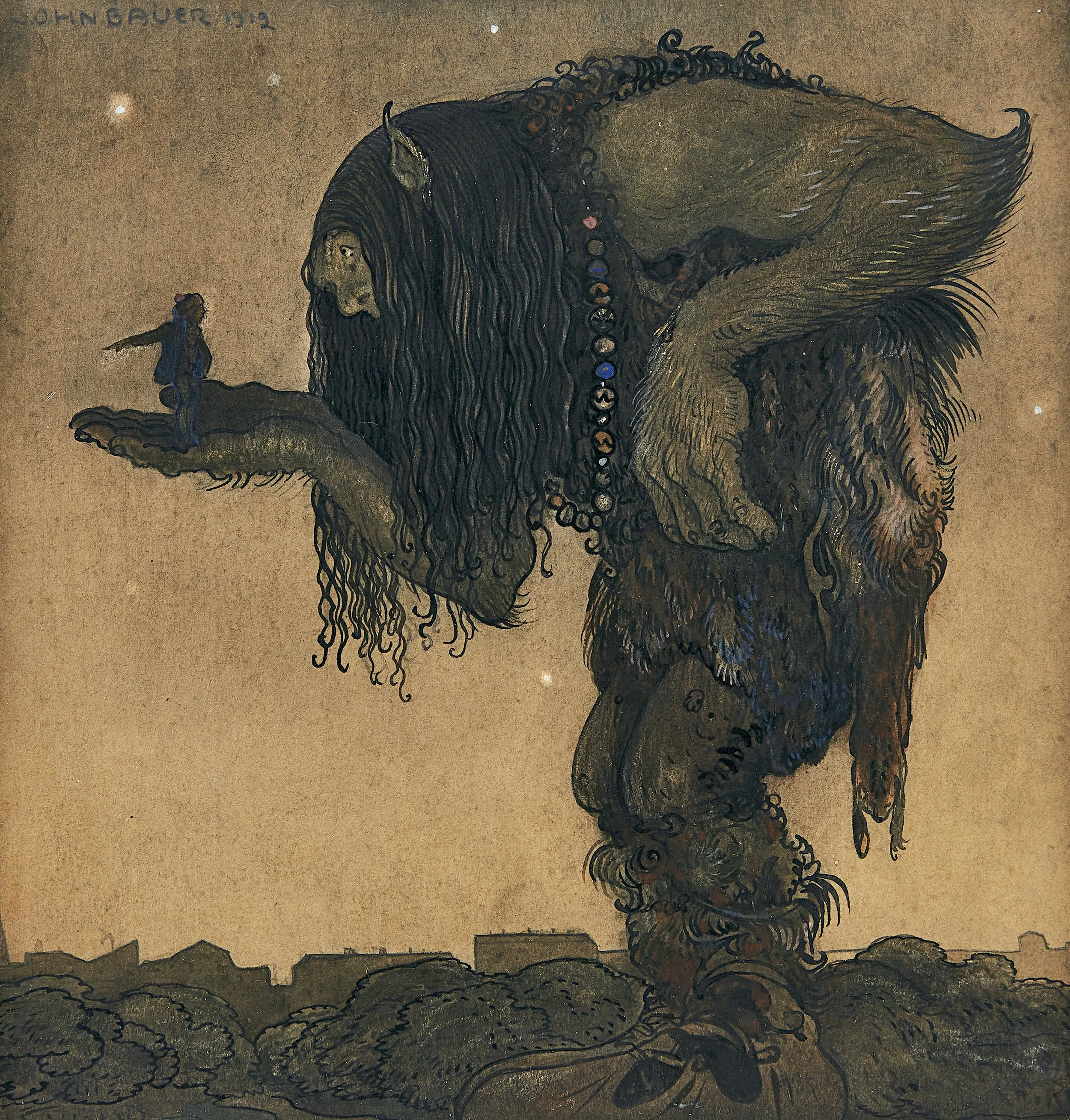
"There! He shouted, it's over there!" by John Bauer 1912
My childhood was of a quite low-tech kind — I had a pink walkman with a handful of tapes. Instead of the digital mess we now surround ourselves with, I did millions of other things. I unsuccessfully tried to catch wild rabbits with my friends, I ran a circus and organised my sticker collection. In that upbringing, stories were a big part of my life. Both at home and in school I got to learn about life through fiction of various kinds. We would be taught Norse mythology in school, a mythology that is much more wild and natural than the Christianity that was later on forced upon us. I got to learn about folklore stories that lived on through oral storytelling before they were written down. Wild creatures such as the male water spirit Näcken or Skogsrået, the beautiful forest mistress who leads men astray, would brutally scare me and my friends as we were playing in the forests. But my favourite stories were captured in Among Gnomes and Trolls, often illustrated by Swedish painter John Bauer. Page after page I would read about magical forests where trolls and princesses would keep me glued to the books.
The reason I've been thinking about this lately is due to the fact that the notion of black and white, of either-or, of dichotomies, has been on my mind. More and more, that mindset seems to be taking over human ways of being and relating to everything around us. The stories from my childhood, though, were not of that kind. The folklore tales and mythologies were way more complex, with characters who were often both evil and kind. They had a depth to them where I, as a child, would learn that life is in fact not at all divided into simple and opposite options.
There is something enormously comfortable in being able to divide our world, options and possibilities into two parts only. Your thinking effort is dramatically reduced and you can quickly come to a conclusion, no matter the topic. It simply feels good, and you don't have to spend days, weeks or even months pondering a topic. I see this around me all the time. In dating, we reject easily as soon as dichotomous thinking enters the picture. A person is either too much of this or too much of that, and we move on to the next.
I also see this in our workplaces. We believe potential future colleagues, or the ones we already have, should behave according to a clear axis of smoothness. Complexity and an understanding of different viewpoints are rarely appreciated. Based on clear divides, you're in or you're out, we need you or we don't, you're valuable or you're not.
But where dichotomy is mostly discussed is, of course, politics at a global level, where the left and right are continuously arguing their way forward. Unfortunately, this affects questions that should sit completely outside of this black-and-white scale, such as equality and climate change, among others. These issues have never been a matter of choosing a or b; they are a complex system that will require a completely different approach if we are to start resolving them for future generations.
Throughout time, many have rejected the theory of dichotomous worldviews. The French feminist thinker Hélène Cixous, for instance, spent much of her writing dismantling the binary oppositions she saw structuring Western thought itself — active and passive, culture and nature, man and woman. She argued these pairs were never neutral; one side was always quietly positioned as superior, the other as lesser, and language itself kept reinforcing that hierarchy. What she proposed instead was a way of writing and thinking that resisted collapsing into opposites altogether, that could hold contradiction without needing to resolve it. bell hooks pushed against a different kind of either-or: the habit of treating race, gender and class as separate boxes to be examined one at a time, as if a person only ever belonged to one category at once. For her, real understanding meant holding all of it together at the same time. Both Cixous and hooks say what I'm circling here: that the pairs we take for granted are not giving us enough options to make humanity grow into something more whole.
I wonder if dichotomy seems to thrive in a world that lacks wholeness, silence and time. To let complex perspectives reign does not mean you let everything pass without taking a stand. It simply means you understand that life is intricate, and that the reasoning that comes with existence is worth not always being solved. Sometimes taking a stand means choosing that third way on purpose — not as an escape from deciding, but as a decision to hold everything a question actually contains, rather than flattening it down to two. Wisdom, then, might be the capacity to carry vulnerable strength, where we dare to create answers that don't come in two, but in an array of broad possibilities. To create manifold versions of ideas and pathways might be the most powerful skill you could have.
I guess what I'm trying to say is that we should not necessarily reach for the simple solutions to problems that arise in our lives. If you take time to sit with the idea that causes you trouble, you might realise that it's not at all a problem with a dichotomous explanation or solution. Trying to force one anyway, squeezing something layered into a yes or a no, is what leaves you stuck. It's a crappy place to be since it leaves you with potentially an even greater problem than the one you first started out with. And I wonder if that is the key in all of this: that we simply want things neatly divided into a clear yes or no. But yes and no were never the only two options. There's a third — the space of maybe — and it doesn't outrank the other two so much as hold what they can't: the whole spectrum between and beyond them. There is a magical opening in that maybe, one that reveals possibilities the other two could never reach on their own.