Uncharted Archaea Territory
I was going to write an article on how it might be time to give up on humanity and return the planet to archaeal leadership. Then yesterday evening I went to a concert, and now I can no longer finish the piece the way I intended. Damn it!
For this to make sense, I might have to start with why handing the planet over to archaeal creatures seemed like a reasonable answer to our planetary crises. But before doing that, some of you might wonder what archaea actually are.
Humans like to learn about the world, and we like to prove things through what we call science. Understanding the world we live in has become a job for many, and each time there is a new breakthrough we feel excitement and even hand out awards to the ones who understand the most. Some of this research saves lives, for example by finding treatments for common human diseases. Other research is of a more philosophical kind. Knowing how many stars there are in the universe is a mind-tickling thought, but it will not truly have an impact on my life. It's simply delightful. One of the many questions we've tackled over the years is how life on this planet started and which types of life currently inhabit the turning globe we call home. The story has shifted over time, but an increasingly accepted model is the two-domain system, a biological classification that groups all cellular organisms in the tree of life into archaea and bacteria. (If you're wondering where you belong, you and all other humans are eukaryotes, a group that branches off from within the archaea.)
Bacteria are microscopic single-celled organisms found everywhere on Earth. Archaea look very similar to bacteria, but genetically and biochemically they are completely different. Their cell membranes are built from unique lipids, which allow many of them to survive in extreme environments. Eukaryotes can be single-celled or multicellular, and within this group we find plants, animals and fungi.
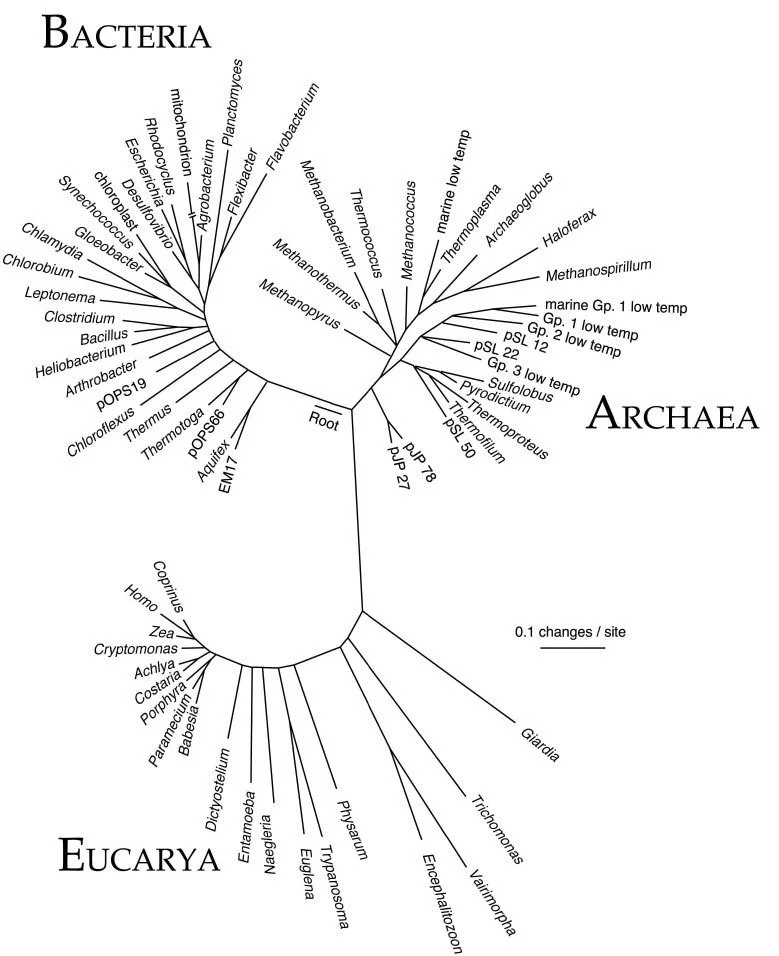
Now that we know the fundamental living groups on the planet, we need to make a little detour into historic climate crises to explain why I thought it might be time to pass the baton to the archaea. Earth has gone through five major mass extinctions, all of them long before humans existed. Most were tied to rapid shifts in climate, often driven by volcanism and greenhouse gases, and in one case by an asteroid impact. The first was the Late Ordovician extinction, 445 to 444 million years ago, linked mainly to cooling and glaciation. It was followed by the Late Devonian extinction 372 million years ago. Third on the list is the "Great Dying", the Permian–Triassic event, which happened 252 million years ago. It is Earth's most severe known extinction: approximately 90 to 96 percent of all marine species and 70 percent of terrestrial vertebrate species went extinct. The fourth is the Triassic–Jurassic extinction, 201.3 million years ago, and the last is the Cretaceous–Paleogene, or K–Pg, extinction 66 million years ago, the one most of us know as the end of the dinosaurs. Some scientists argue that we are now living at the beginning of a sixth mass extinction.
So if Earth has experienced several wipeouts before, what is different this time? Many suggest that today's climate change is happening much faster than during previous events, leaving life struggling to keep up. Evolution requires time, and when change happens slowly, some species can adapt genetically or migrate. I know that speed is precisely what decides how many make it. And yet part of me keeps wondering: whether fast or slow, these events seem to end up so brutal anyway. Wouldn't it almost be better to have it over and done with?
As a thought experiment, I've played with the idea that humans will simply die out along with many other life forms. It's a dark thought, but the image still contains a turning planet where new life will eventually return. It has done so before, and we know that is how the process works, even if it takes millions of years. The life forms most likely to make it in that scenario are the ones most resistant to shocks: fungi, algae, bacteria and archaea. From this geological, biological and cosmic perspective, our current climate change is yet another blip in the system. A blip, however, in which you and I happen to live.
But back to the archaea. I have a proposal to make. What if they are the ones meant to live on Earth, and we are not? I know the universe probably doesn't "mean" anything by it, but it's a fascinating question and I find it strangely logical. Humans are no "better" than any other species, and history shows that small life forms are true survivors. In fact, they were there at the very beginning of life and made it possible for so many others. They are also masters of disaster: when most other life dies out, bacteria, archaea, algae and fungi have often bloomed, cooperating and spreading in vast microbial mats. Meanwhile, it was our large human brain that gave us the fossil-fuelled technology now heating the planet. In short, that brain might turn out to be a great disadvantage. And if we followed this line of thought, if we truly wanted to hand over to someone else, what would we humans like to do during our last era of reign? Would it be to keep killing each other and other species, to commute to a boring job, or to watch others go without enough food? I imagine the opposite. Living with the knowledge that you will die can give many of us a more generous perspective. (And yes, we will all die, but somehow most of us seem to forget that.)
This is where I have to weave in a few philosophical thoughts. A friend of mine argued that I fall into nihilism with these ideas, but I'm not sure that is where I'm coming from. I don't subscribe to the belief that life, morality and truth have no value at all. But there is something in the nihilistic premise that intrigues me, and I'm not the only one who has wrestled with it. Jean-Paul Sartre, for example, rejected the nihilist label, but he argued that because we aren't born with any given essence, we exist first and must then define who we are through our actions. With that comes complete freedom, which is at the same time a heavy burden. Albert Camus took a different path. He argued that trying to construct an artificial meaning was a form of evasion, and he described what he called the absurd: the irreconcilable collision between the human desire for meaning and a silent universe. According to Camus, people usually try to escape this tension in one of two ways: physical suicide (giving up) or philosophical suicide (turning to religion or ideologies to invent a meaning). But he proposed a third way, which he called revolt: to face the absurd with open eyes and live fully and passionately anyway.
I've completely lost the thread here, I know. I promised to explain why I couldn't finish this article the way I planned, and that will now follow. There is something strange in the concept of "making it". Will humans make it? We seem to ask that over and over. But I've never fully understood what it is we are supposed to make. Do we mean making sure all humans survive? Or making sure all life survives? Both alternatives are genuinely sweet, but very unlikely. Some will make it, others will not. And I kind of liked the idea of the archaea making it while we don't.
But then, as I mentioned, I went to a concert yesterday, and it forced me to shift perspective. In a full concert hall in Paris, I watched Ólafur Arnalds for a few hours as he and his fellow musicians took us all on a wonderful journey through art. The title of his tour, "Falling Apart Together", framed his thoughts on humanity, and he kept returning to the magical parts of human life. The part where love is at the core. Perhaps that is what Camus meant by revolt: knowing everything might fall apart, and making something beautiful together anyway. As I walked through the buzzing streets of a breathing city afterwards, my thoughts on small life forms as the solution felt wrong. Because even though they are highly skilled survivors, they do not feel love. Or at least, that is what we understand of them. Other animals may love in their own ways, but the love I felt in that room, the kind we put into music and art and share with strangers in the dark, is something I would miss. And a planet without it would honestly just be a sphere floating around in the dark universe. Not inherently a bad thing. Just slightly dull.
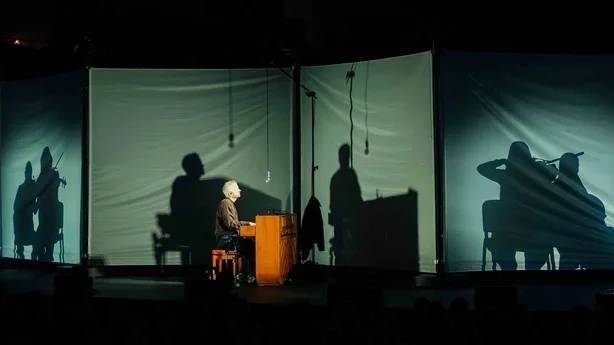
Ólafur Arnalds at Salle Pleyel, Paris.
P.S. No matter what we do, planet Earth has an end date. As the Sun slowly grows brighter, Earth's oceans are expected to evaporate in roughly one billion years. In about 5 to 7.6 billion years, the Sun will run out of hydrogen in its core, expand into a red giant and likely engulf or vaporise Earth. Even the archaea have a deadline.
P.P.S. Archaea already live in our guts. We host and feed them, and they live alongside us. It makes it hard to draw the line of what makes up a person. Is it the matter, the soul, or both? I like to think that my matter belongs to the Earth and that I am, above all, my thinking world, my soul if you wish. And yet I'm not sure where I end. The fact that I may already be carrying the organisms that will keep living on Earth after I'm gone weirdly challenges this article's reasoning. Who is supposed to go on living?