Courage Is Not Comfort
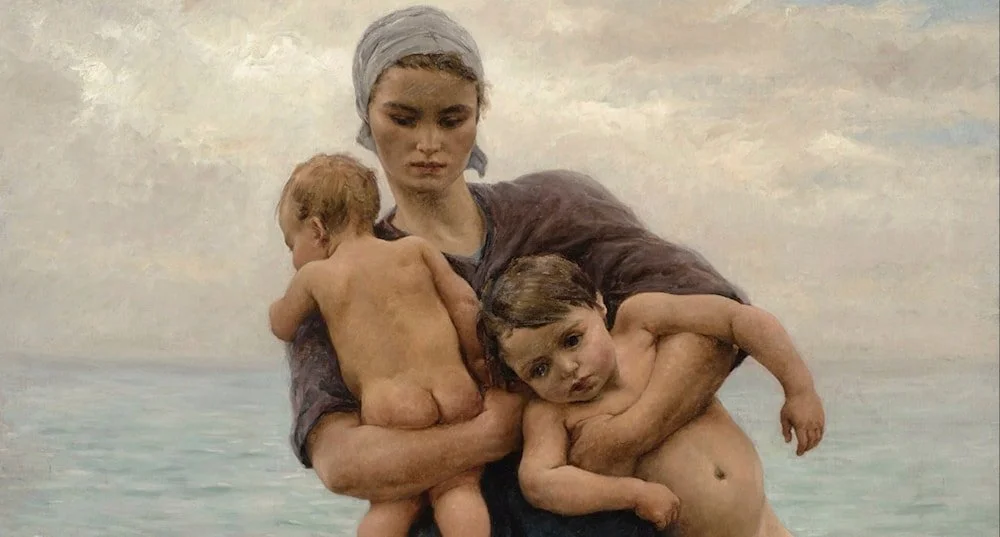
Fisherman Woman coming to Bath her Children by Virginie Demont Breton, 1881.
We tend to think of courage as a thing we activate when we're in clear physical danger. Yet I want to talk about a much smaller, much harder courage — to be vulnerable and speak the truth. As human beings we so desperately avoid that space of fragility, to save ourselves from being pushed away and isolated, I suppose. This summer that vulnerable bravery crossed my path in unpredictable ways, from private relationships to seeing politicians respond (or not respond) to climate change and to experts in various fields showing up more personally than ever before.
The idea of pondering human courage is old. Aristotle-type of old. And most likely long before that as well, although we miss the written proofs. Aristotle placed courage as the mean between cowardice and recklessness — two failure states either side of the brave middle. There's a twist though: both failure states are actually forms of comfort, not just fear-avoidance. To be a coward can be a very convenient state, especially if hidden by an air of knowledge, expertise or social skills. Same goes for the reckless souls who are very often seen as inspirational and daring, who have somehow found the satisfying meaning of not giving a damn about anything. Somewhere in between is the room for the truly brave, according to Aristotle. In Nicomachean Ethics, Book III, he discusses this in-between space: "Hence also courage involves pain, and is justly praised; for it is harder to face what is painful than to abstain from what is pleasant."
I had to read that sentence a few times, to remind myself of what I kind of already know but need to hear again. It is so enormously distressing to face what is painful, and to do it by your own free will.
So why do we sometimes reach for uncomfortable truths? I would argue we reach for them for the people we love, to move both them and ourselves toward a state of meaning. Psychologist Susan David frames this by pointing out that we're all prone to self-doubt, shame, sadness, fear or anger — beliefs that can too easily steer us in the "wrong" direction. Her "emotionally agile" people aren't immune to any of this. What she argues is that they adapt better to what life throws at them, aligning their actions with their values, making small but powerful changes that compound into a lifetime of growth. David believes in courage over comfort, following, whether she knows it or not, in Aristotle's footsteps.
Last week, the Swedish entrepreneur and climate advocate Ingmar Rentzhog published an essay on his media platform We Don't Have Time. I've followed his work for years, along with hundreds of thousands of others on the platform. But this article hit a new chord and made me read his text more carefully than usual. Rentzhog suddenly spoke with a new voice, a lot more vulnerable, as he stated plainly that he believes the idea that "we have time," in relation to climate change, is a lie. He connected that belief not only to his work, but to his fear as a parent, watching his children grow in a world not only unknown, but also brutal. He then named a second lie, equally devastating: that it's all too late — which creates the exact same retreat as the first, just from the other direction. Nothing can be done, so we don't have to keep trying.
Both lies are what care and love do when they're afraid — pretend things are fine, or pretend nothing matters. Not what they do when they're brave: to stand up tall even when you're feeling lonely. When a male entrepreneur talks about his children, wondering out loud about their future, he clearly opens a door to courage at a time when being vulnerable is not exactly rewarded.
Which brings us back to the work of Susan David again. She talks about "bothness" — feeling fear fully while simultaneously holding what you value, at the same time, not one after the other. The ability to sit with what scares you while acting anyway. It's a powerful skill that requires effort, and the belief that you can stand steady by yourself. To tell someone you love them, not knowing if they love you back. To lead a company down a very different path than everyone else in your sector. To stand up for a person in public who might need support. To be vulnerable in your work, daring to expose emotion at a time when rational data is what gets valued.
We have all felt fear this summer. It has a shape, and the shape has numbers.
Western Europe just lived through its hottest June and July on record — 21.62°C on average, 2.79°C above what used to be normal, breaking the previous record set in 2022. In a single week during the June heatwave, Europe recorded roughly 10,650 excess deaths. France and Spain fought their worst fires in living memory. And the IPCC's own floor — 250,000 excess deaths a year by 2050 — is described by the people who wrote it as conservative, counting only four causes of death and leaving out storms, floods, and everything that follows from them. I share these numbers to show that fear can be measured against data, but numbers were never the hard part to fix.
How we walk with fear cannot be measured. Courage is an immeasurable thing and only matters when we feel it rather than put it into a spreadsheet. In that sense, courage is a link between what we see and what we feel.
Somewhere in the last few months I stopped believing that comforting the people I love and being honest with them were the same act. For a long time I thought they were — that if I loved someone enough, I would find a way to make the hard thing feel less hard. I'm no longer sure that's love. I think it might just be fear, wearing love's clothes.
Courage, it turns out, is not the dramatic kind we save for burning buildings. It's smaller than that, and it happens far more often than we'd like. It's saying the true thing instead of the "what everyone expects me to say"-sounding thing. It's letting someone you love feel the full weight of possibilities.
I don't think we get to skip this. Not the deniers among us, and not the ones who've already decided it's hopeless — both, it turns out, are just choosing which comfort to hide in. The rest of us are left standing in the harder, less flattering middle, where nothing is resolved and nothing lets you off the hook.
Courage is not comfort. It’s a painful act that requires you to hold both knowledge and emotions at the same time. But, and this is a vulnerable thing to state, the courageous pain comes with a wonderful feeling of lightness once the act is done and over. The human mind is a strange thing!
_____________________________________________________________________________________
Aristotle, Nicomachean Ethics, Book III — courage as the mean between cowardice and rashness. Secondary reference: Pury, C.L.S. & Mulkey, A.A. (2016). Courage. In Encyclopedia of Personality and Individual Differences. Springer. https://doi.org/10.1007/978-3-319-28099-8_498-1
Aristotle. Nicomachean Ethics, Book III — courage as the mean between cowardice and rashness. https://sacred-texts.com/cla/ari/nico/index.htm
Rentzhog, I. (2026, August 20). The Biggest Lie Ever Told Is Only Four Words Long. We Don't Have Time. https://thebiggestlie.wedonthavetime.org/
McKay, A. (2026, August). The Gargantuan Lie That is Collapsing The World's Climate. Current Affairs. (referenced within Rentzhog's essay)
Supran, Rahmstorf & Oreskes (2023). Assessing ExxonMobil's global warming projections. Science. https://www.science.org/doi/10.1126/science.abk0063
Copernicus Climate Change Service (2026, August). Highest July global ocean surface temperatures as exceptionally hot, dry conditions fuel wildfires in Europe. https://climate.copernicus.eu/copernicus-highest-july-global-ocean-surface-temperatures-exceptionally-hot-dry-conditions-fuel
Copernicus Climate Change Service (2026). 2024 the first calendar year to exceed 1.5°C above pre-industrial levels. https://climate.copernicus.eu/copernicus-2024-first-year-exceed-15degc-above-pre-industrial-level
Reuters (2026, July 12). Europe recorded 10,650 excess deaths during the late-June 2026 heatwave, data show. https://www.reuters.com/business/environment/europe-recorded-10000-excess-deaths-during-late-june-heatwave-data-show-2026-07-12/
IPCC AR6 Working Group II (2022). Health fact sheet — excess of 250,000 deaths per year by 2050. https://www.ipcc.ch/report/ar6/wg2/downloads/outreach/IPCC_AR6_WGII_FactSheet_Health.pdf
David, S. (2016). Emotional Agility: Get Unstuck, Embrace Change, and Thrive in Work and Life. Avery. (Note: paraphrase her "courage over comfort" and "bothness" framing rather than quoting directly — her phrasing is close enough to a signature line that it reads as reproduction.)