TO LEAD OR NOT TO LEAD
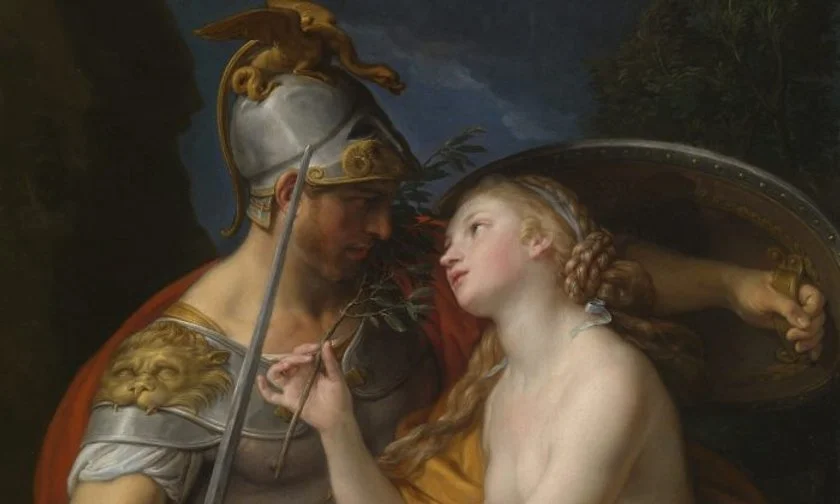
Allegory of Peace and War’ by Pompeo Batoni, 1776
Key lecture for FUTUREMAKERS at Université Côte d'Azur
I've been invited today to share some thoughts on leadership, and I will already now prepare you for a wild mix of random thoughts and messy connections. The topic, leadership, seems to be an action and a concept that requires us to dive deep into what frightens us, moves us and forces us to lean into discomfort. And maybe, the need for leadership is only required in a world out of balance and harmony, so the topic itself is somehow automatically relating to human problems. The leader is purely there to make sure we cooperate and create structures at our highest standards.
Most of my career I have spent exploring human designed systems and our ability or inability to transform societies for the better. I've looked into strategies, processes, infrastructures and agendas to understand if there are ways to, once and for all, shift our ways of living on this planet. But sometimes I wonder if that is impossible. What if we are simply built wrong and no matter what we do, societies will always come with a dark side? What if none of the institutions, none of the plans, none of the careful architecture we design actually changes anything, because the design flaw is within us, not in our systems? What is the role of a leader then?
These types of questions are not new — in fact we've been dealing with similar thoughts throughout our whole existence. What is a human? How do we live well? What is required of me as a person? What is required of us as a group? To feel less lonely in my thinking, I often lean in and fall safely into the hands of other great minds.
In Shakespeare's Hamlet, we read "to be, or not to be, that is the question" as if it's only about life and death. To live or not to live. But what if this question asks more? I think it's also about a man standing completely still while everyone around him waits for him to act, not knowing if action will make anything better. That stillness is confusing, a state we never wish for. And yet it falls upon us — that quiet melancholy of not knowing, while wondering about the next step.
But what if we change one word in Hamlet's question and sit with it for a while. Not "to be," but "to lead." To lead, or not to lead. Because underneath the military buildup, the border politics, the global economic tensions and the AI governance debates, I think this is the actual question everyone in power is quietly asking: do I hold on, or do I let go — and which one takes more courage?
Hamlet never answers his question. He delays it for four more acts, and by the time he finally moves, almost everyone he loves is dead. I don't have a clean answer to my question either. But in this brief lecture I will keep returning to a handful of people who each, in their own way, refused to let the question sit unanswered the way Hamlet did — a ruler who thought he was god, two women who refused in entirely different ways and a few strange, quiet examples of something that might inspire our work. I will walk through what I found in three acts, and then, at the end, tell you what I personally think.
But before getting there we need to picture the scene. We need to see the scenography as a backdrop to our story, one that creates the framing. For this play, the scene is our current world with the many and brutal global risks we are facing collectively. They stack powerfully on systems maps, and we look at them, we read about them, we try to understand them — but rarely manage to fully do so, since their structure and impact is so immense our brains seem unable to take it all in. Nor do we know where to start, or what to focus on.
And while we try to understand, time passes and the world keeps moving. Despite our shortcoming to comprehend, we can absolutely feel. The heat. The wars. The fears. Where the mind stops being functional, the body reads the world perfectly. Which makes me wonder — are current leaders letting themselves feel beyond their intellectual capacities? And what would happen if they did?
There is also another notion I want to add here to make the scene vivid, and that is my reasoning on war and peace. In a world run by constant fears and urgent conflicts, there are no possible moments to solve the slower, quieter threats. We stay stuck closing the critical risks without ever being given the time and space to resolve other, less immediately pressing tasks — such as inequality for example. A leader who wants to create a deeply meaningful impact needs peace since that is the only framework that can give us the opportunity for true problem solving.
Our current geopolitical realities are forcing defence back onto every policy agenda. But the dominant response — to build a stronger military — reproduces the very logic that generates instability. Can we afford not to do the opposite: to ask what it looks like to design for durable peace, and to build the institutional, spatial and economic architectures that make it possible? Without peace and humanity in harmony, are we ready to face the massive ongoing risks of climate disaster, inequality and human meaning?
ACT I: The Soliloquy of the Ruler
It’s a lonely space sometimes, to lead. Just like Hamlet, it's easy to doubt directions and possibilities. Or at least, that is what I hope all healthy leaders would do every now and then. The ability to question yourself and your worthiness of leadership seems to me to be a graceful method. Yet, unfortunately I suspect this is rarely the case. Many leaders bulldoze their way through their careers without daring to listen more carefully.
To clarify various forms of leadership, let’s look into the most brutal type - the leader as a ruler. This has been a popular structure throughout history and it’s also been a truly damaging type of leadership. Through different models of absolutism, this type of leader thinks they know all answers. The leader as a ruler voices their own agenda rather than being the voice for the people. They've fully misunderstood what a leader is, and what a leader can be. Throughout history we find them everywhere, and in our current political landscape they’re equally present.
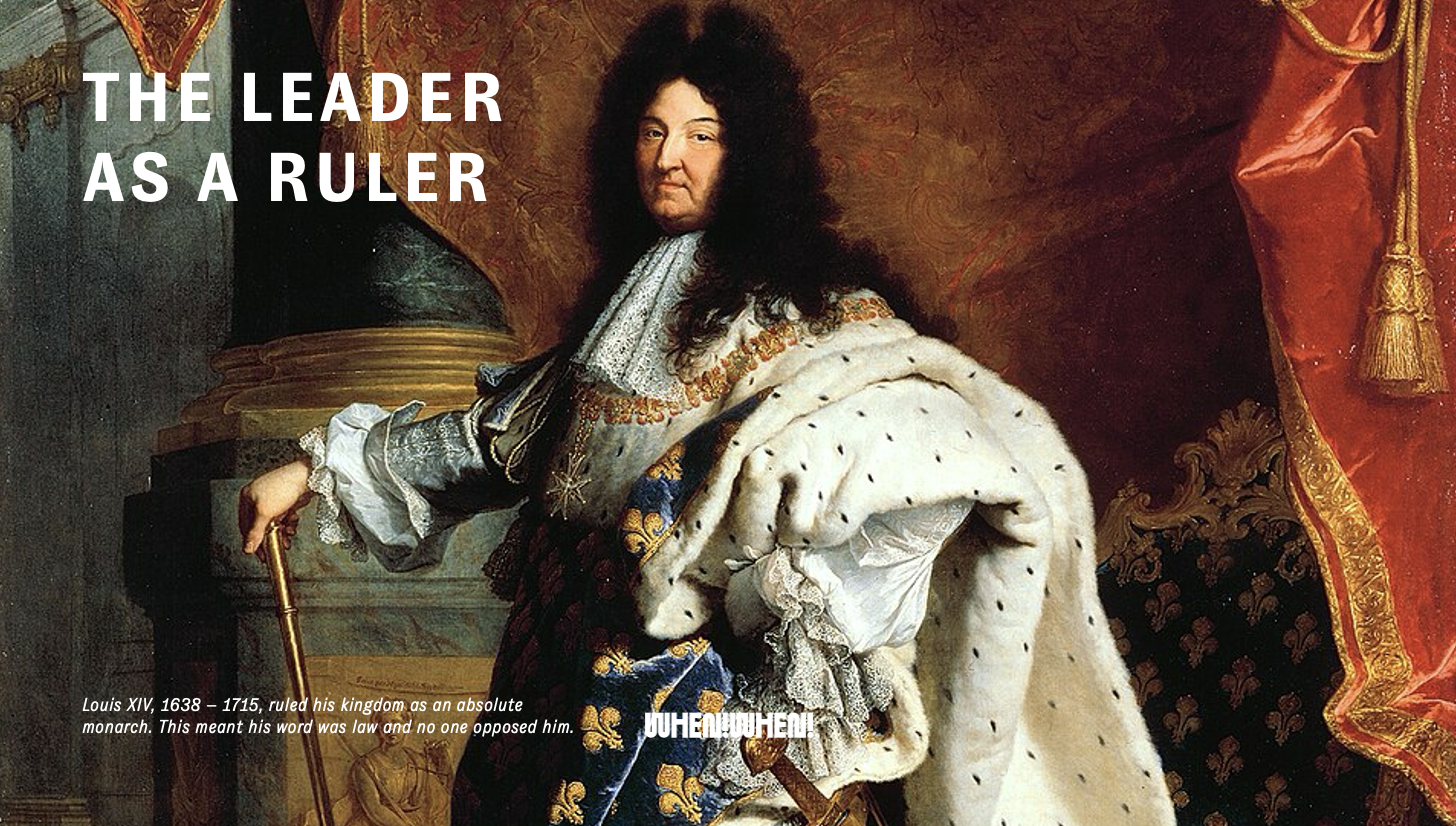
I wonder if this is based on a misinterpretation of the actual foundations of leadership and our understanding of it. To be a leader is to be in a vulnerable position. Your role is to gather large amounts of thoughts and ideas, to then host them and voice them in arenas where you represent people, thoughts and visions. It was never about one single person flashing out their own ideas and then brutally going for it while saying it's for the best for everyone and everything. To be a leader was never about the leader. It was always about the group and about shared problems and possibilities.
But even leaders who do try to follow the principle of working with problems and themes for the people are facing difficulties. Current global leaders seem to be focusing on a tight list of important matters. And yet I'm simultaneously left with a feeling that they are missing something — that they stay with the obvious and never deal with the larger logics underneath it.
Drawing across multiple sources — from geopolitical analysis to global summits to what leaders are actually debating right now — there are 10 main focus areas I see currently dominating national leaders' agendas. It's not a surprising list; it's a classic, stable stack of areas to work with.
What's striking about the list is the underlying tension running through almost all of them. The old multidimensional rule-based order is fracturing, and leaders are simultaneously trying to manage that breakdown while competing within it. We can see things are changing, but no one dares to be the first to move in a different direction.
The deeper problem is that capitalism is driven by an incessant search to accumulate money through profits, creating exponential growth because that is the safe order we have created for ourselves. Even though we now know that the economy is linked to resources which in turn is linked to finite planetary resources. Our entire political systems are funded by, and embedded within, that logic. Challenging it means challenging your own power base — and risking everything. Very few are wired to step out of this declining reality to build something new together.
Still, genuine movements exist. Finland, Scotland, Wales, New Zealand and Iceland have formally signed on to a wellbeing economy, committing to put human and ecological wellbeing at the centre of policy rather than growth.
And these aren't just words. Scotland has restructured budget priorities around wellbeing. New Zealand replaced GDP with a "Wellbeing Budget" in 2019, measuring success by child poverty rates, mental health and ecological health instead. Iceland has run four-day workweek experiments. Wales has piloted universal basic income and has also passed a ‘Well-being of Future Generations Act’ — arguably the most legally binding post-growth legislation anywhere, requiring every public body to weigh the long-term impact on future generations, not just the economic return.
So the substance exists. What's missing is the will to name it. A major study published by London School of Economics in 2025 found that around 80% of UK citizens and 70% of US citizens already support the core ideas of degrowth — reducing harmful production and prioritising wellbeing. Yet almost no national politician in either country will say the word out loud. The researchers were clear about why: public resistance isn't the problem. It is rather a lack of opportunity to engage with the idea that is missing. Which means politicians and policymakers should start discussing these topics to engage and create knowledge.
But where is brave work being carried out then? It seems to me that the people doing the genuinely daring thinking right now are mostly outside formal power. They sit within academia and free organisations disconnected from governments and policy.
The question worth sitting with is: will change then come from leaders, or will it come despite them? History suggests it's usually the latter.
And since we've been talking about who gets to hold this kind of power — it's worth naming plainly that leadership, as an institution, is a brutally patriarchal business. In 2026, only 28 countries are led by a woman. 101 countries, out of 193 UN member states, have never had a female leader at all. That's roughly half of our global nations.
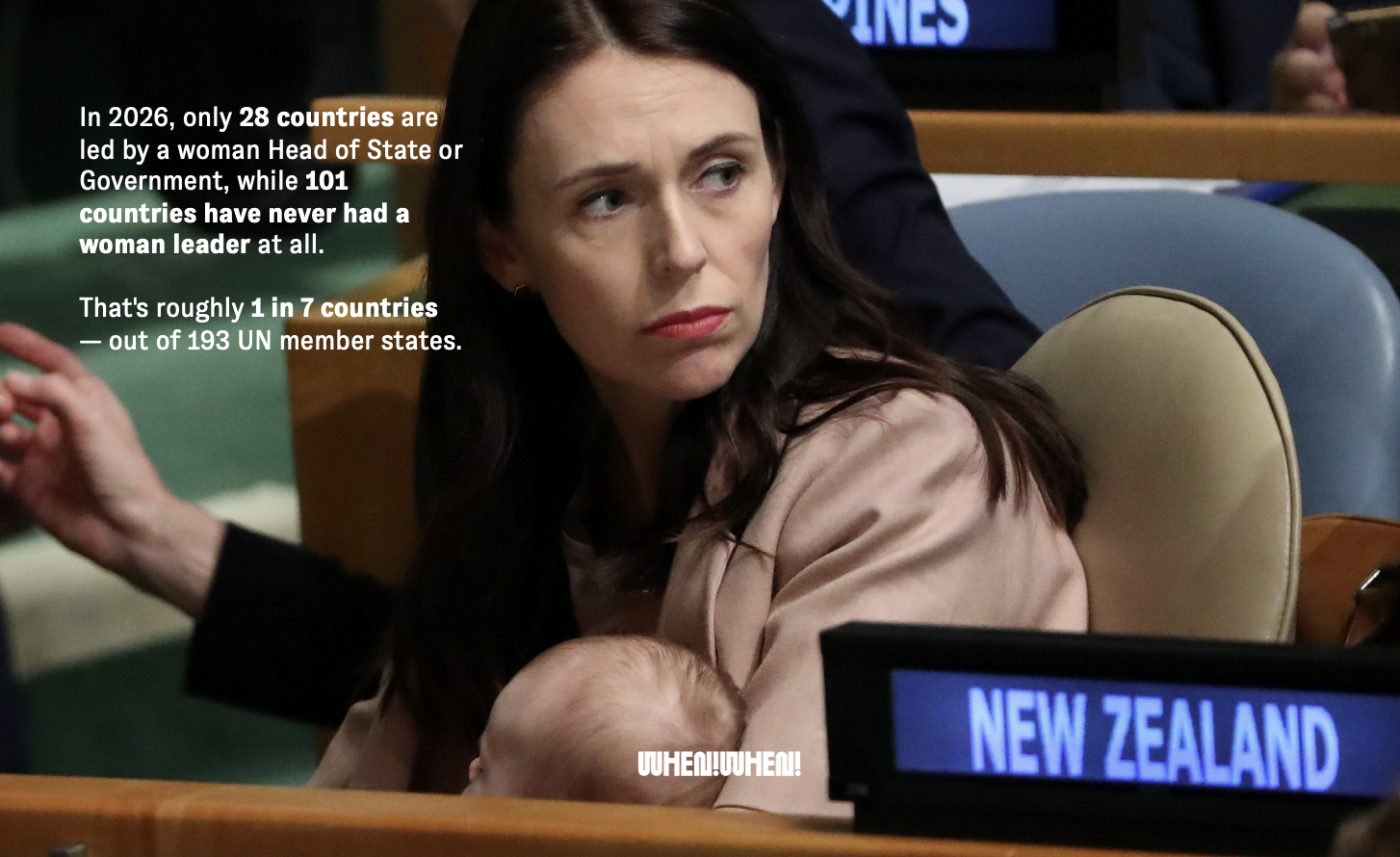
Jacinda Ardern, fomer prime minister of New Zealand.
Jacinda Ardern did not only lead New Zealand as their prime minister from 2017 - 2023, she is also one of only two elected heads of government in modern history to give birth while in office (not in her actual office, but you understand what I mean). Benazir Bhutto, as Prime Minister of Pakistan, is the other, in 1990. It’s a small detour in this lecture, yet something worth keeping in mind while exploring leadership and what it requires of not only the person leading but what we demand of that person as well.
So, to conclude act I. What if the leaders we need today must understand that balance, harmony and peace is the only way forward?
ACT II: TO REFUSE
We've now looked at the setting of the scene, and act one took us through the sole ruler and some current political schemes. If we take a step back in act two, we might see a pattern. Underneath nearly all of the ten leadership agendas, we find the same old instinct: when something frightens you, you hold it tighter, and you build more. More weapons, more walls, more rules, more products, more power.
That's one answer to Hamlet's question. You don't fix the man — instead, you build a structure that makes him feel safe, one that he can't easily break. A successful leader in that worldview knows how to make people feel secure, but based on the wrong reasoning, and with weak integrated structures for the future. I believe leaders will need to rethink this space, and step out of their comfort, refusing what has been rehearsed for them.
Queen Christina of Sweden was standing inside exactly that moment of unwillingness, and at the height of her power, she simply left it. Abdicated the throne. I would argue it wasn't a decision based on weakness, but much closer to a disciplined surrender of the self — a recognition that a role can stop fitting what you actually believe leadership should be, and that putting it down can be a braver act than holding on. She chose not to be the ruler, and had the courage and means to follow through. And as a side note, after her abdication she relocated to Rome where she continued to engage in politics and culture, forming friendships with influential figures and supporting the arts. A very cool woman to choose freedom.
Audre Lorde is a very different example to Christina's kind of solitary abdication. Let me explain this further. Hamlet gets to deliberate for as long as he likes while the world waits for him, because he's a prince. Christina was a queen, and even though abdication was most likely not an easy process, she had a safety net of some sort. But Lorde — she wrote for people who were never given that luxury. Who can't truly choose, or wait, but simply need to hold on.
Audre Lorde believed humans must refuse to ignore, fear, or destroy human difference. Instead, she urged people to use their differences as sources of power and creative growth. Furthermore, she argued humans must refuse to accept silence, avoid being passive and resist participating in their own oppression or the oppression of others. For her, refusal was a liberating tool.
Put Christina and Lorde next to each other and something interesting happens. Both of them realise that power and leadership was never about a throne at all. It was always the act of speaking and refusing systems created for you, even when they seem too large to break free from.
ACT III: BEYOND THE QUESTION
So if leadership isn't about the crown, and if real leadership requires some kind of refusal — what does it look like when that refusal has to become collective? When one voice has to become many, and one person has to learn to hold power gently instead of alone?
As UN Secretary-General from 1953 to 1961, Dag Hammarskjöld's public job was, quite literally, to broker peace between nations — he led negotiations to make the world a safer place. His private diary, Markings, shows a man who understood that genuine leadership is the opposite of command: a slow burning-away of ego, a discipline of interior surrender, in order to act rightly in the world.
In Markings he writes: "You wake from dreams of doom and — for a moment — you know: beyond all the noise and the gestures, the only real thing, love's calm unwavering flame in the half-light of an early dawn."
The quote is beautiful on its own but gets filled with real meaning when you know the full story of Hammarskjöld and that he died in service to his work. His plane went down on a peace mission in 1961, many suspect the plane was shot down. Letting go of the ruler's version of power was a philosophy for him but it also cost him his life. I think that's the part we're not allowed to skip past if we're going to take the quiet version of leadership seriously — it isn't automatically more gentler than the ruler's version. It just acts out differently.
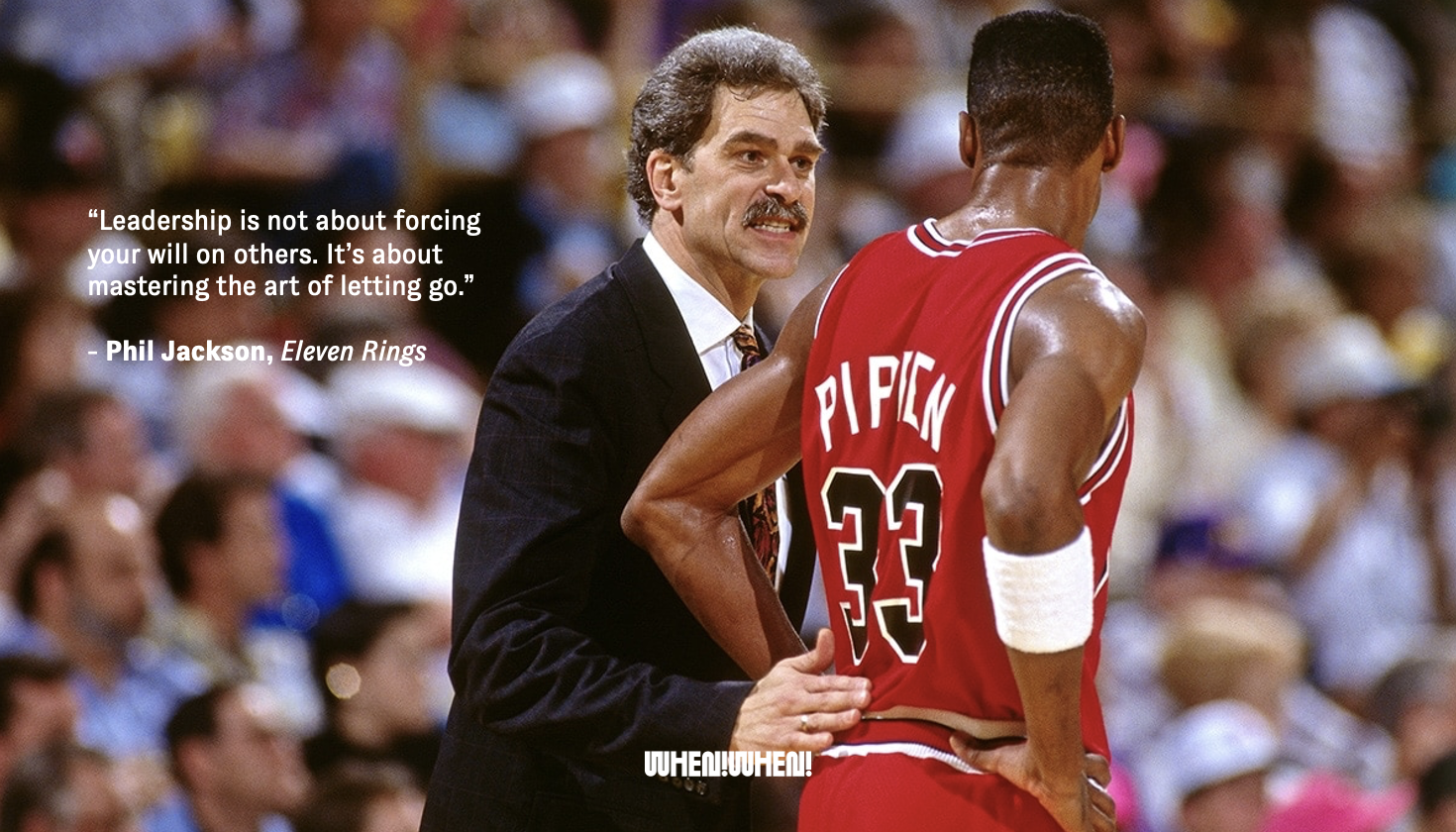
Phil Jackson coaching one of his players.
I find the same shape, oddly, at a much smaller and possibly more naive scale, in an American basketball coach. Phil Jackson won eleven NBA championships doing something close to what Hammarskjöld describes, but on a court instead of a battlefield of nations. Jackson was famous for running the "triangle offense," a system that distributed the ball and decision-making across all five players rather than funnelling everything through one star. He stayed quiet on the sideline during plays rather than constantly directing, trusting his players to make decisions in real time. After the games he would constantly give credit away on purpose, steering praise towards the players, and let them hold each other accountable instead of doing it for them himself. The paradox of Jackson is that by consistently stepping out of the spotlight, he became one of the most celebrated coaches in sports history. His restraint was his leadership.
Nobody died for this one. That's exactly why I want it here next to Hammarskjöld — it shows the same discipline doesn't only exist at the scale of global leadership. It's something you could actually practise on a random Tuesday, in your everyday life.
However, there is more to say on this, because both of these men make letting go sound like something you arrive at — a discipline you master. Ursula K. Le Guin says something more melancholic and complex, and I think it's closer to reality for most of us: "We're each of us alone, to be sure. What can you do but hold your hand out in the dark?" She doesn't promise that the loneliness goes away once you've let go of power. She just says: reach out anyway. Not because you've resolved anything or know what will happen, but because it's the only thing left to do.
That, to me, is a potential answer to Hamlet. There is no mastery to be found in working this out by yourself. Instead, this is an act you do together.
CURTAINS DOWN
So — to lead, or not to lead? Hamlet asked his question alone, at midnight, with no one to answer him back. I've gone the opposite way, and I'm asking my question out loud. Who gets to lead, why, and for what reason? For billions of people to get organised and structure ourselves, leaders are useful tools. They simplify an enormously chaotic arena of constant noise, where nothing would otherwise be heard. Still, it requires a certain amount of kindness and grace.
For me, to lead or not to lead could be a question for each and every one of us — but also for every leader currently in a position responsible for others. The scale doesn't matter here; a leader needs to hold to certain agreements no matter how many people they serve.
A great leader is mindful. They face fears and are still humble. They know that the agenda they lead with is collective, not theirs. The questions on the table come from the people, and the leader is simply a tool, a voice, that gathers the broader dialogue into one.
A great leader is visionary. They see beyond reality — not by adding their own personal thoughts to the menu, but visionary in the way they lead. They know when to refuse, when to let go, when to invite, when to be generous, and when to give up. They see far-away futures, and know that each decision will have enormous consequences for this world, in ways we can never fully understand.
Finally, a great leader is generous. Loving, even. Because they know it was never about them — and that what matters most in the world is genuine care. Not a shallow care that looks good on paper, but a deep, personal care that makes you feel vulnerable. A great leader knows that in the end, the only thing that matters is love.
I believe a sensible leader needs all three agreements. Only when they work together do we create the collective voice that is essential to democracies, and to freedom. If I earlier asked the larger question of what a human might be, how we might live well or how we constantly wonder what is required of us. Just like Hamlet, these questions might very well stay as unanswered questions and maybe that is where the beauty of it lives.
For more than 400 years we've been following Hamlet and his question. And the glorious dilemma surrounding it is that we will never come up with a reply. The only thing we can do is play with its reasoning, and enjoy the space of not knowing. For us today, the question could sound different, and possibly fill the void of Hamlet's loneliness.
It’s maybe not "to be, or not to be" — but "to be, together, or not at all."
I will leave you with a few minutes of Hamlet, performed by Andrew Scott, and hope that I have planted some thoughts on leadership in this very stormy, but also profoundly beautiful, world.