The Paradox of SUFFERING
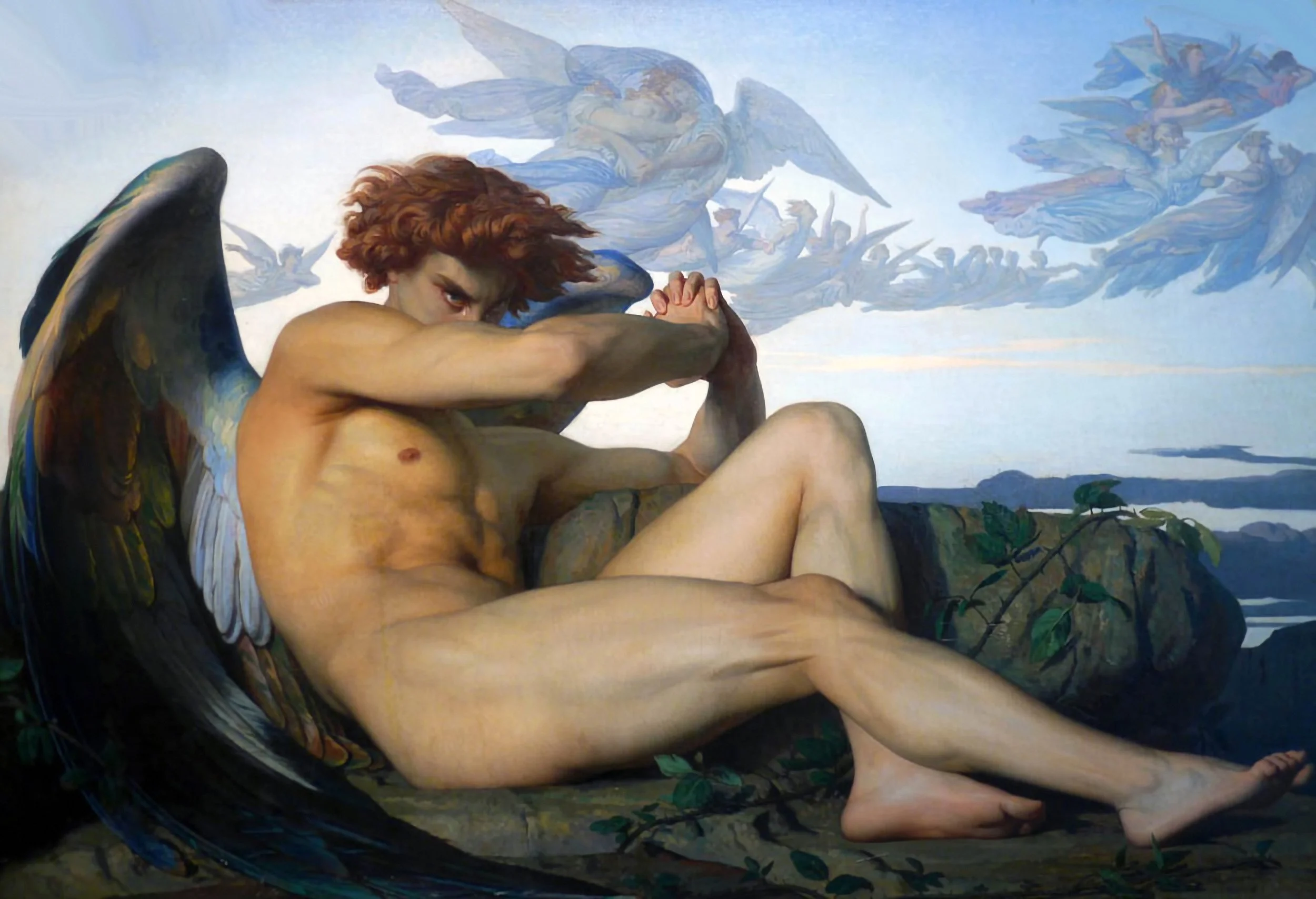
‘The Fallen Angel’ by Alexandre Cabanel, 1847
I’ve been wondering for a while, quietly in a somewhat personal space, how suffering makes me a more resourceful human. I’ve noticed how earlier moments of massive pain, junctures where I’ve been ruptured, damaged or even close to leaving this life, have led to unexpected growth and taught me how to live in balance with the world around me. And I’m seeing how current struggles are not making me fearful, but how they rather pull me in and gently force me to sit with the pain as it runs through my system. This all asks a central question: Why does suffering, despite its cruelty, so often bring us clarity, bravery and sometimes even meaning?
Many philosophers have since long grappled with this paradox, and while their insights are profound, I’m also noticing that these thinkers, recorded in books and writing, are overwhelmingly male. As always, when I lean into historic guidance, I wonder where the women’s voices are in the conversations. But I’ll get back to that later.
“Only great pain is the ultimate liberator of the spirit….I doubt that such pain makes us ‘better’; but I know that it makes us more profound.” wrote Friedrich Nietzsche in his book ‘The Gay Science’ published in 1882. Nietzsche claims that suffering is the “discipline” that has elevated humanity, that greatness and suffering are inseparable; to affirm life is to embrace its pain. Maybe even more explicitly, he develops these thoughts through the idea that everything recurs infinitely over an infinite period of time, and within that thought lies the reality of both suffering and joy. Nietzsche’s general outlook on this, to love fate, was a way to accept life. Or at least, that is my interpretation of his work on Amor Fati (love of fate). “My formula for greatness in a human being is amor fati: that one wants nothing to be different, not forward, not backward, not in all eternity. Not merely bear what is necessary, still less conceal it—all idealism is mendacity in the face of what is necessary—but love it.”
“Only great pain is the ultimate liberator of the spirit….I doubt that such pain makes us ‘better’; but I know that it makes us more profound.”
In a slightly different, maybe slightly darker tone, was Arthur Schopenhauer pondering on suffering as life’s only reality. “Life,” he famously wrote, “is a business that does not cover the costs.” This way of thinking turns suffering and joy into mathematical components that we can thoroughly add up within our own personal accounting to keep the books in check. “Pleasure and well-being is negative and suffering positive, the happiness of a given life is not to be measured according to the joys and pleasures it contains but according to the absence of the positive element, the absence of suffering.” Schopenhauer saw pain and desire as the engines of human action, but not as the love of fate as through Nietzsche’s perspective. Yet, is there also meaning to be found somewhere in Schopenhauer's bleakness?
I’ll throw in a third perspective, one by the Romanian philosopher Emil Cioran. He saw suffering as the sculptor of the self: “I owe to suffering the best parts of myself.” Cioran believed there is value in pain, that suffering is a teacher, a revealer of depth and new experiences. Cioran has a more personal, almost poetic approach that differs from Nietzsche’s grand pronouncements and Schopenhauer’s pessimistic view of a human life. “Having always lived in fear of being surprised by the worst, I have tried in every circumstance to get a head start, flinging myself into misfortune long before it occurred.” Reading about Cioran, I find myself with a question that lingers uncomfortably as I move through the texts. And it’s really not about Cioran at all. It’s about equality. Do some suffer more than others, and if so, and if there is a paradox in suffering, who lives more profoundly?
I quickly shake that feeling off, it might be wise to not compare the ways we suffer at all. So, now that we sit with theories of suffering by male philosophers its time to go back to my promise of continuing another chain of thoughts on who’s voices we first find when we search for them. Where are the female voices, the female philosophers, in this canon? “How much of this truth can I bear to see and still live unblinded? How much of this pain can I use?” wrote Audre Lorde in her book ‘Need: A Chorale for Black Women Voices : Pin’ from 1990. Through a more modern tone she grasps for the same principles as the male philosophers generations before her. The question of how much pain she can use lifts the conversation into a space of possibilities and hope. In a vulnerable way she asks how much of her suffering she can transform into an actionable outcome (without stating if this outcome would be seen as positive or negative).
Last week, American writer and activist Rebecca Solnit, wrote an article in The Guardian: “What technology takes from us – and how to take it back”. In a way, it’s a modern take on human suffering. Solnit beautifully captures how technology has created distance between us, how we have become isolated islands in a landscape that used to be filled with relational collectives. She writes: ”I want to praise difficulty, not for its own sake, but because so much of what we want, we get through endeavours that are difficult. The difficulty is why doing something is rewarding; you have accomplished something, exerted effort and skill, stayed with the trouble, tested your limits, realised your intentions – or sometimes failed at all these things, and that too can be important, as can learning to survive failure.” I wonder, are we so deep down into the suffering Solnit describes that we aren’t able to, as Nietzsche suggests, elevate ourselves just yet. Drawing from personal experience, I know that hardship comes and goes, that it often has a peaking moment before it slowly starts to wither. Is Rebecca Solnit brilliantly looking upon humanity as we stand on the peak of technological suffering? Possibly. And we won’t know until we’ve distanced ourselves from this specific pain.
Suffering has that ability to strip away illusions and force us to see what matters. Yet, there is a fine line between romanticising suffering and brutally having to accept its transformative potential. We rarely get to choose the suffering that happens to us, which somehow lays out the rules of the game - Amor Fati. And if we take Cioran's approach of using suffering as a way of sculpting ourselves, then suffering ends up being a tool to carve out curves, shapes and structures. In that beauty, of an objects or an organisms transformation, suffering become not solely a tool, but a wondrous motion that leaves a space for endless possibilities.
References:
’Ecce Homo’, Friedrich Nietzsche, 1967
‘On the Suffering of the World’, Arthur Schopenhauer, 1850
‘The Trouble With Being Born’, Emil Cioran, 1973
‘Need: A Chorale for Black Women Voices : Pin’, Audre Lorde, 1990