In Defense of Love
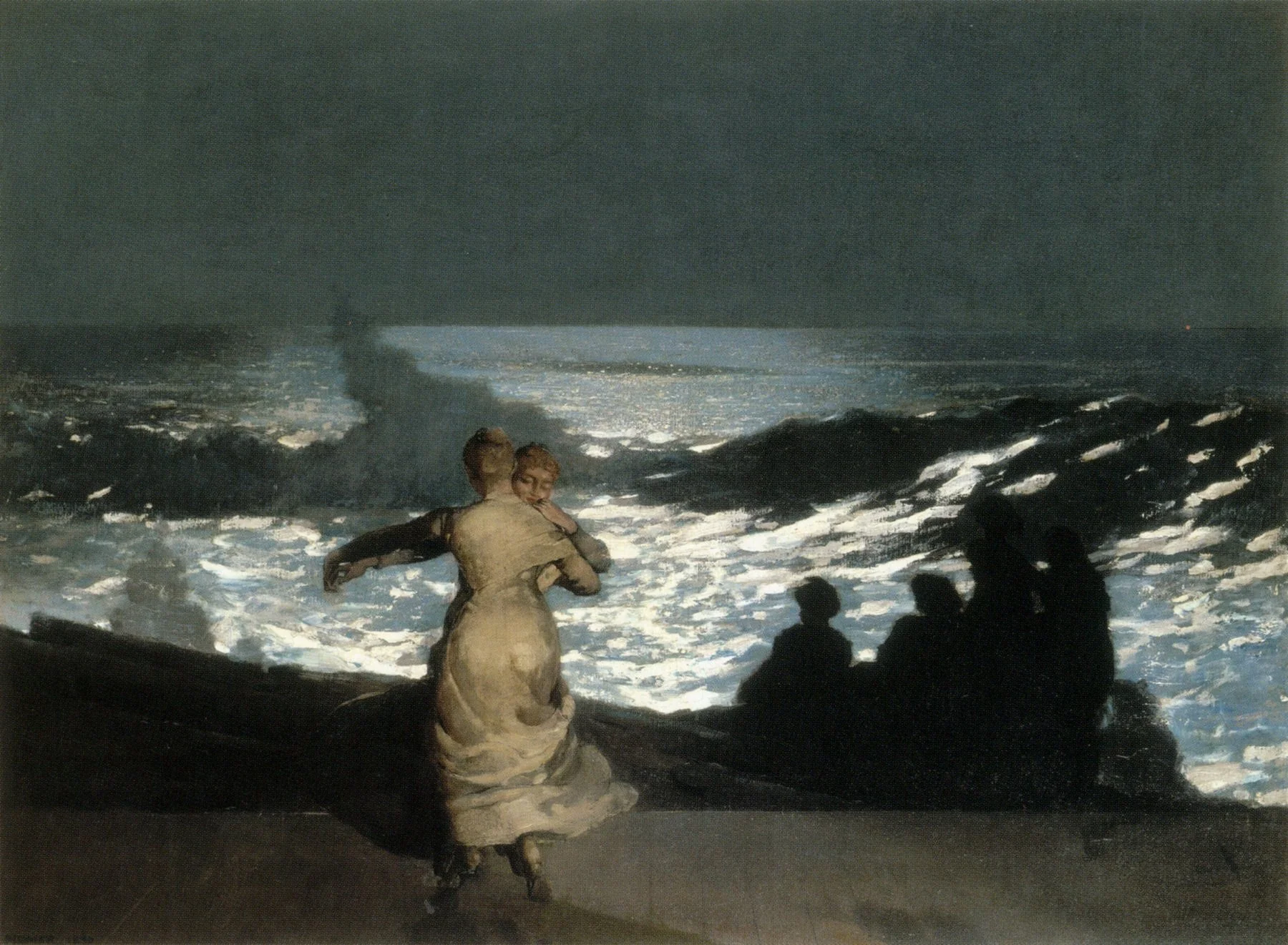
‘A Summer Night’, Winslow Homer, 1890
In Defense of Love as a Serious Strategy in a Fear-Driven World
Why fear has reached its limits and love is no longer optional
A human loves because love is how we survive, connect and become more than just being a tiny breathing organism. It is how our strange existence turns into a meaningful moment. Without love, a life is of an empty nothing. Lo, and behold! you might think. What is this reasoning?, you continue. Do we need to love to truly live? You are right, this sounds romantic, to the point where it seems farfetched. But give me a moment. Trust that this is a logic of a different kind. Fear has reached its limits and offbeat rationales are maybe the best options we have left.
Love as a serious strategy emerges from different systemic histories, realities and layers. Additionally, these systemic layers blend with our own personal love stories into undefined and indefinite complexity. Let’s start to unfold this weave into something more comprehensive. So that maybe, it will make sense.
Love is an ancient biological survival technology. Through deep emotional bonding, humans kept infants alive, held groups together and made cooperation possible. Our brains evolved oxytocin, dopamine and attachment systems, not to make us poetic, but to make us stay with each other. Because together, we were better. Love became the glue of collective life. Families, friendships, movements, cultures, art, none would function without some form of profound care that exceeds what we can explain. Love is what makes “we” possible.
But love also moves beyond the biological chemicals. It gives coherence to the self. Through loving and being loved, we learn who we are and who we want to be. It regulates fear, mirrors our worth and lets us risk growth. Without love, the mind fragments into defense and loneliness.
Humans love because we are aware of finitude. Loving is how we push back against impermanence, not by denying death, but by saying that this life mattered. So a human loves not because it is easy or safe, but because love is how life insists on being felt. On being fully experienced.
But what I’ve noticed, by looking at the world through my window, is that love is also one of the few forces strong enough to loosen fear. And fear is what keeps our current and very broken systems intact. Love may be the best solution I have found so far, and there are reasons for that.
Love and fear
If love can be a systemic force, we need to be precise about what kind of love we are talking about here. It is not romantic love, not sentimental stories or tales of the prince and the princess. The love I am talking about is of an infinite kind. Beyond the feelings between two people. It is love as a meaning of all. It is love that is simultaneously rational and arational at the same time.
To frame this better, let’s look at two viewpoints of love; bell hooks and Plato. In hooks’s book “All About Love” she states that; “The word "love" is most often defined as a noun, yet al the more astute theorists of love acknowledge that we would all love better if we used it as a verb”. To love in her opinion is not a simple state of an emotional experience, it is how we are. How we live. And how we do it together.
Plato on the other hand, explored love in his Symposium (c. 385 – 370 BC) through Diotima’s Ladder of Love. In the text, Diotima describes love as a process of education and transformation, a gradual ascent from desire for the particular to love of the eternal and universal. In Diotima’s view, love is the engine that moves humans from desire to meaning, from possession to participation and from fear of loss to intimacy with the infinite. Each step of the ladder includes the previous one but loosens attachment, expands care, and deepens understanding. From the first steps of physical desire to a specific body and all bodies, to the love of souls and knowledge and to the final step where the lover perceives beauty itself as not embodied in one thing. The ladder shifts a human from loving things that are beautiful to loving beauty as a principle of being.
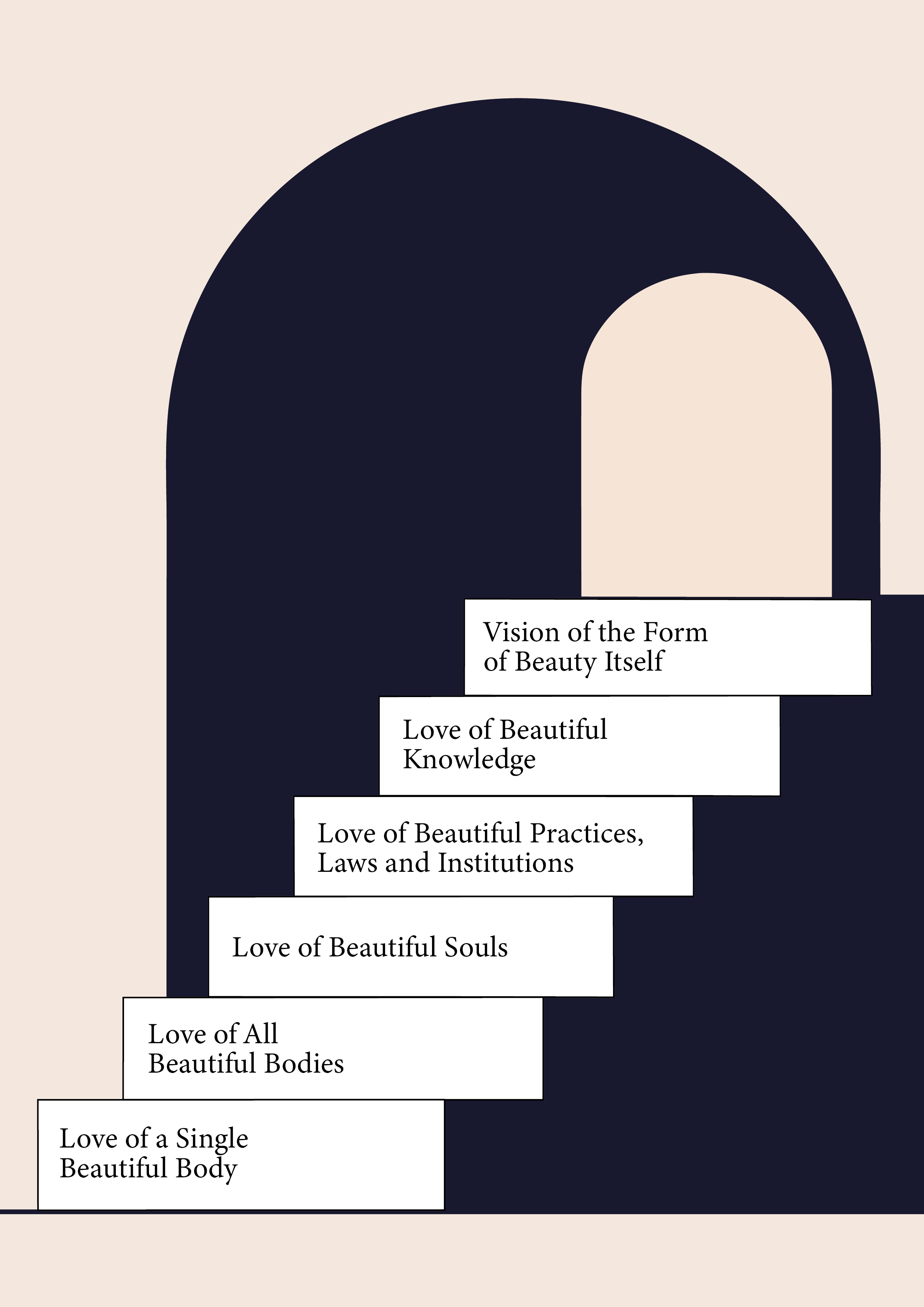
Diotima’s Ladder of Love
Together, hooks and Plato propose love that matures by widening its scope and deepening its responsibility. Diotima offers orientation (what love grows toward) while hooks offers grounding (how love survives power, fear, and trauma). Together, they say:
Love is not what saves us from the world,
it is how we stay and remake it.
Then what is the world we need to be saved from? I would argue it is the fear-based leadership and ego-driven careers where violence and trauma is achingly present. Fear is too often the root operating system. The fear of loss, the fear of not mattering, the fear of unknowns, the fear of loneliness, the fear of grief, the fear of death. Leaders throughout time have actively tried to regulate fear with rules, incentives, or punishments, but only with temporary results. Fear always finds another outlet. Love might be the only force that actually dissolves fear, rather than managing it. Not by suppressing it, but by making it unnecessary.
Love changes behaviour at the deepest layer
Most solutions we see around us to face our planetary crises are interventions that target materiality, resources, economy, behaviours or incentives. Love targets identity and belonging. A human full of love feels seen without performing, feels valued without winning and feels safe without dominating. They no longer need the devastating need of ego boosting, control, extraction or dehumanization. Violence and cruelty are often symptoms of unmet belonging, not inherent evil.
The question becomes, how can love be embedded into governance (care-based policy design), economies (regenerative, mothering, cooperative models), organisations (psychological safety, shared purpose) and leadership (stewardship and generosity)? How do we design systems that make love a default condition rather than a heroic exception? Love needs to become infrastructure, way beyond a personal virtue. Every stable, non-violent human system is secretly a love system. When love is absent, fear fills the vacuum. Love is a force that works at the root level of structures, let’s embrace it as the serious strategy that it really is.
Am I asking you to love as much as you can? Yes! Love as hard as you can, as much as you can, until it’s painful but where you still put a smile on your face. If love is a serious strategy, it deserves our most sincere capacity. Radiate love, share it wisely, but most importantly, make sure it shows up where you least expect it. Maybe it’s there, in the cracks of our systems, that love is needed the most.